Application of SEND Data for Analysis

Project Overview |
|---|
The project focused on use cases for SEND data related to analyses provided on tables for general toxicology studies. Commonly, the nonclinical study analyses in industry practice are performed using raw data extracts, while the SEND datasets are created outside of this in a separate process. This project examined these purposes and identified some standard analyses that could be performed using the SEND package. |
Identified Need/Challenge |
|---|
As the implementation and exchange of SEND data is becoming more prevalent in the industry, focus is directed towards the usability and fitness for use of the SEND data. The usability of SEND data is essential in order to harvest the benefits of more efficient review and analysis. |
Project Scope |
|---|
The project focused on individual SEND domains in a prioritized manor (FW, CL, MA, MI mainly). Scientific questions that may arise during review of SEND data were discussed. SEND domain specific analyses using example analysis keys (i.e. SEND variables) were identified to aid in getting the right answers from the SEND datasets. |
Vision |
To describe use cases for SEND data that may provide the industry with a common platform to communicate and assess how SEND supports data "fitness for use" and provides quality context for review of study data. |
Transverse Collaborative Investigations |
|---|
|
Deliverables |
|---|
SEND Domains Examined | |||
|---|---|---|---|
Domain Name | Data Type | Source System | Link to document page |
FW | Individual Non-rodent | PDS - ToxData | |
FW | Individual Rodent | Provantis | |
FW | Cage-based Rodent | Provantis | |
FW | Individual Non-rodent | Pristima | |
CL (Qualitative Food) | Individual Non-rodent | PDS - ToxData | |
MA | Group summary non-rodent | PDS - ToxData | |
MA | Group summary non-rodent | PDS - ToxData | |
MA | Individual Non-rodent | Provantis | |


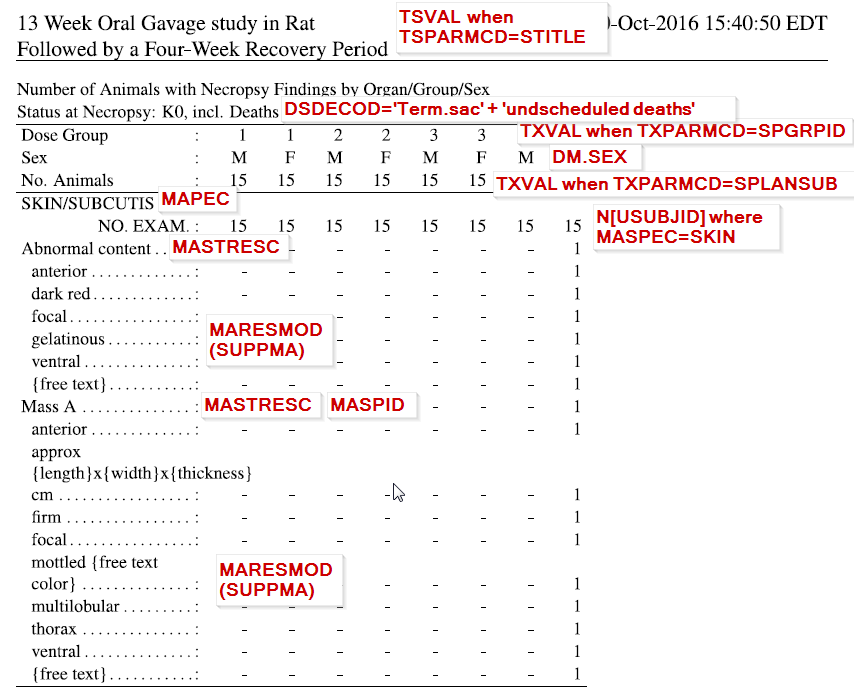


SEND Variable Annotation Examples | |
|---|---|
Document Name | Link to document page |
ePaper |
|
Tox tables mapped to SEND | |
Tox table illustration | |
Sample BW report with annotation | |
Sample BG Individual listing with annotation | |
Sample LB Clin Chem Individual listing with annotation | |
Sample LB urinalysis data - individual and summary | |
Sample CL data - individual and summary | |
Sample CL data 2 - Individual | |
Sample CL data 3 - Individual | |
Thomas' overview of study data | |
Master Thesis, Thomas | |
Master Thesis, Thomas, Presentation | |
